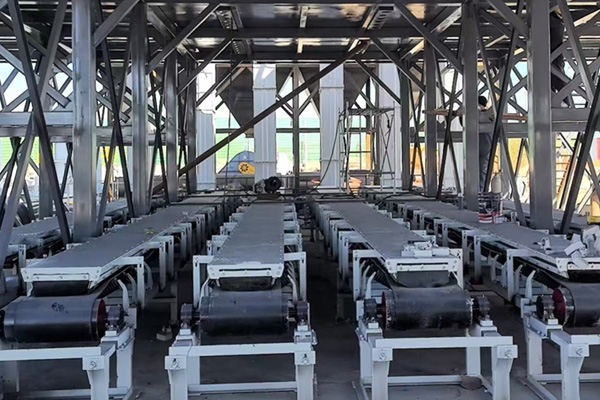
The operational efficiency of a screening production line is closely related to the matching degree of equipment. Belt conveyors, with their scientifically designed mechanical structure, overcome the shortcomings of traditional conveying equipment, such as high noise, high loss, and susceptibility to failure, becoming the standard conveying equipment in screening production lines. Their overall structure is modular and simplified, with clear division of labor and strong coordination among components. This not only ensures stable conveying capacity but also endows the equipment with core performance advantages such as low energy consumption, low loss, and easy maintenance, fully adapting to the normalized and high-intensity operation scenarios of screening production lines.
The belt conveyor consists of five core modules: a drive system, a load-bearing conveying system, a support system, a tensioning system, and a protection system. These modules work precisely together to ensure efficient operation. The drive system includes components such as a motor, reducer, and coupling, employing a flexible transmission design. It provides uniform power output and controllable speed, allowing adjustment of the conveying speed according to the operating load of the screening production line. This achieves precise matching between the material conveying volume and the processing capacity of the screening equipment, avoiding insufficient material supply or material accumulation and overflow problems. The conveyor system uses a high-strength rubber conveyor belt as its core, combined with wear-resistant and tensile-resistant materials, to withstand the wear caused by long-term friction and impact of materials, making it suitable for high-intensity continuous operation. The support system consists of densely arranged idler rollers and a rigid frame. The idler rollers rotate flexibly with minimal resistance, providing comprehensive support for the conveyor belt and material weight while minimizing operating friction and energy consumption.
The tensioning system is a key structure ensuring the stable operation of the belt conveyor. Through screw tensioning, hydraulic tensioning, and other methods, it continuously maintains the appropriate tension of the conveyor belt, effectively solving problems such as belt slackness, misalignment, and vibration after long-term operation. This ensures the conveyor belt always maintains a flat, closed-loop operation, preventing material deviation and spillage. The protection system includes anti-misalignment devices, emergency stop devices, overload protection devices, and cleaning devices. It can monitor the equipment's operating status in real time, providing timely warnings or shutdowns in case of abnormalities such as belt misalignment, equipment overload, or material blockage, comprehensively ensuring the safety of the equipment and production line.
Based on its sophisticated structural design, the belt conveyor exhibits four core performance characteristics in the screening production line. First, it boasts high energy efficiency. The overall operating friction resistance is low, resulting in minimal power loss. The uniform conveying mode eliminates the need for frequent start-stop cycles, reducing energy consumption by over 20% compared to bucket and scraper conveyors, demonstrating significant long-term energy savings. Second, it features low wear and long service life. The absence of rigid mechanical meshing reduces friction and impact between materials and equipment/components, slowing wear on core components and significantly lowering replacement and maintenance costs. Third, it offers superior operating conditions. The machine operates with low noise and vibration, and the well-sealed conveyor belt effectively suppresses dust diffusion from screened materials, optimizing the production line's working environment. Fourth, it offers strong speed adaptability, enabling stepless speed regulation to precisely match the processing rhythm of the screening equipment, ensuring smooth transitions between production lines and significantly improving overall screening efficiency.
The modular design of the belt conveyor makes disassembly, maintenance, and component replacement more convenient. It eliminates the need for extensive equipment disassembly, allowing for quick routine maintenance and troubleshooting, minimizing downtime and maximizing overall production line efficiency.