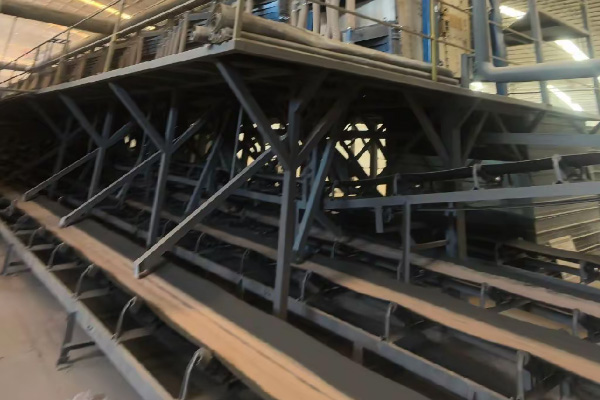
Spring returns to the earth, and all things revive. With rising temperatures, increased humidity, and more frequent sandstorms, your belt conveyor also needs a thoughtful switch from "winter mode" to "spring mode." Many businesses may overlook the impact of seasonal changes on this continuous conveyor equipment, leading to inexplicable problems like belt misalignment, slippage, or material blockages after the Spring Festival. Don't worry, this is likely not a problem with the equipment, but rather a need for "seasonal calibration." Today, we'll discuss three essential "soft adjustments" for belt conveyors when starting operations in the spring.
I. Why is it necessary to readjust the "tension" in spring?
Explanation:
In the low temperatures of winter, the conveyor belt rubber hardens and shrinks. We usually reduce the tension appropriately to prevent damage from excessive tightness. However, in spring, as temperatures rise, the conveyor belt rubber gradually regains its flexibility and undergoes thermal expansion, resulting in a slight increase in length. Simultaneously, the large temperature difference between day and night in spring can cause the belt length to vary from several millimeters to several centimeters between day and night. If not adjusted in time, the conveyor belt may become too loose when daytime temperatures rise, causing the drive roller to slip.
Adjustment Recommendations:
Before full-scale operation begins in early spring, it is recommended that you inspect and adjust the tensioning device. If it is counterweight tensioning, check if the counterweight is touching the ground or support; add counterweight or adjust the tension stroke as needed. If it is screw tensioning or hydraulic tensioning, increase the tension force appropriately to ensure that the conveyor belt does not slip on the drive roller. After adjustment, conduct a no-load test run and observe whether there is a delay or slippage sound during startup.
II. Increased Humidity: Beware of "Roller Slippage" and "Material Adhesion"
Causes:
In spring, air humidity increases, especially during the "return to spring" weather in southern regions, making it easy for water films to condense on the roller surface. When the friction between the drive roller and the conveyor belt is insufficient, slippage will occur. In addition, damp materials easily adhere to the roller surface and idlers, leading to accelerated wear of the roller coating, idler jamming, and even conveyor belt misalignment.
Parameters and Fine-tuning Techniques:
1. Roller Anti-slip: Before starting, check if the roller surface is damp. If a water film is found, run the machine unloaded at low speed for a few minutes to dry the surface using frictional heat. For continuously damp environments, apply a suitable amount of rosin powder or a special anti-slip agent to the roller surface to increase friction.
2. Starting Method: In spring when humidity is high, it is recommended to use a two-step starting method followed by a continuous start to avoid slippage due to insufficient instantaneous friction.
3. Strengthening the Cleaning Device: Check and adjust the fit between the scraper and the conveyor belt (gap ≤ 1mm) to ensure timely removal of adhering materials on the return belt surface and prevent materials from being drawn into the rollers.
III. Increased Wind and Sand: Recheck "Anti-deviation" and "Sealing"
Cause Explanation:
Spring is windy, and outdoor belt conveyors are easily affected by wind, especially when unloaded or lightly loaded. Wind can cause the conveyor belt to deviate. At the same time, dust particles brought by windy weather can easily penetrate the idler bearings, roller bearings, and electric rollers, accelerating wear.
Adjustment Recommendations:
1. Anti-deviation Calibration: Thoroughly inspect the condition of the self-aligning idlers. If the conveyor belt is slightly misaligned, adjust the deflection angle of the self-aligning idlers (each self-aligning idler should deflect in the direction of deviation, making gradual, fine adjustments to avoid over-adjustment leading to reverse deviation).
2. Bearing Seal Inspection: Check the seals of the idler and drum bearing housings for integrity. In areas with severe wind and sand, consider installing dust covers. For exposed lubrication points, clean the dust around the grease fitting before adding grease to prevent sand particles from entering the bearings with the grease.
The operating status of equipment often changes subtly with the seasons. These three spring "soft adjustments" are simple to perform but can effectively help you avoid many subsequent problems. If you encounter any questions during the adjustment process, please feel free to contact us.
Miranr Xinxiang Machinery wishes you a prosperous spring start and smooth conveying!